How Much Does It Cost to Install a Generator?
Typical Range:
$1,545 - $8,734
Typical Range:
$1,545 - $8,734
Cost data is based on actual project costs as reported by 4,150 HomeAdvisor members. Embed this data
.
.
.
.
.
.
.
.
.
.
.
.
.
.
.
.
.
.
.
.
.
.
.
.
.
.
.
.
.
.
•
•
•
•
Updated May 27, 2022
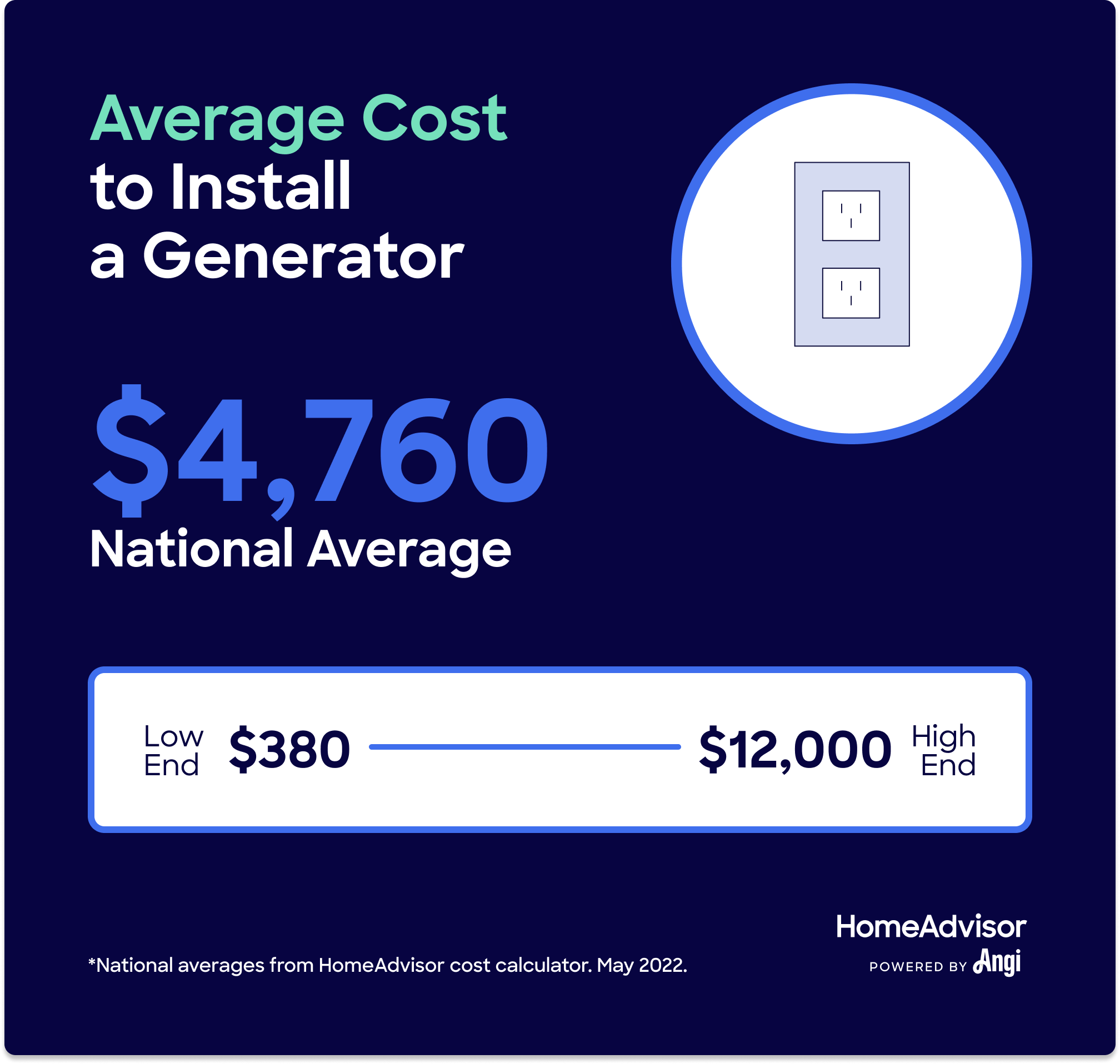
Reviewed by Salvatore Cutrona, Angi Expert Review Board member and founder of Cutrona Electric, LLC, in Sherman, CTInstalling a backup generator costs $5,129 on average, or between $1,545 and $8,734. You have various options to choose from, including whole-house, partial, standby, backup, and portable generators. These also come in various sizes and fuel types, such as gas, propane, and battery-powered.
For example, standby whole-house generators range from $5,000 to $25,000 after installation, while emergency portable generators average $1,500 to $6,000 after installation. Labor, circuits, transfer switches, and concrete pads make up around $500 to $5,000 of those prices.
Let's calculate cost data for you. Where are you located?
Where are you located?
| National Average | $5,129 |
| Typical Range | $1,545 - $8,734 |
| Low End - High End | $350 - $13,000 |
Cost data is based on actual project costs as reported by 4,150 HomeAdvisor members.
You’ll spend approximately $500 to $18,000 for most generators, depending on the type and what you need it for. Large homes may require up to $45,000 for a standby whole-house generator. Average costs by type include:
Backup or portable: $500–$2,000; typically for emergency use and aren’t usually wired into your home or mounted
Critical system or partial: $2,000–$6,300; powers just the critical systems, like heat, lights, and kitchen appliances
Whole-house: $5,000–$18,000; powers the entire house
Price ranges vary from $500 to $50,000, depending on both capacity and if it’s air- or liquid-cooled. Most models over about 30 kilowatts (kW) require liquid cooling, which adds a few thousand dollars to the base unit price.
| Generator Size in kW | Unit Price Range | Typical Use |
|---|---|---|
| 1 – 6 | $500 – $1,800 | Portable backup sizes |
| 7.5 – 10 | $2,000 – $3,500 | Critical systems backup and large portables |
| 14 – 18 | $4,000 – $5,500 | Critical systems for medium-size homes |
| 20 – 24 | $5,000 – $6,500 | Whole house for small homes; critical systems for large homes |
| 26 – 32 | $6,500 – $15,000 | Whole house for medium to large homes |
| 36 – 38 | $14,000 – $16,000 | Whole house for large and very large homes |
| 45 – 48 | $16,200 – $21,000 | Whole house for very large homes |
| 60 – 80 | $21,500 – $31,000 | Very large whole-house systems with many amenities, like a sauna or heated pool |
| 100 – 150 | $32,000 – $50,000 | Extremely large homes with high energy demands or small businesses |
Generac is a popular generator brand. Read the table below for Generac generator costs.
| Model | Power Output in kW | Starting Cost* |
|---|---|---|
| Portable models | 2,200 watts – 1.7kW | $500 – $4,000 |
| PowerPact #6998 | 7.5 | $2,050 |
| Guardian #7172 | 10 | $3,900 |
| Guardian #7228 | 18 | $5,800 |
| Guardian #7043 | 22 | $6,300 |
| Guardian #7290 | 26 | $7,150 |
| Protector #RG030 | 30 | $13,200 |
*Cost includes transfer switch but not labor or other materials
Several types of generators exist for your home. Read more about each kind in the following section.
Whole-house generators cost $17,000 on average for most homes, depending on your home size and energy needs. About 60% to 70% of the total project cost is just for the unit itself and doesn’t include the propane or natural gas line or liquefied petroleum (LP) tank needed to power the generator. Whole-house systems power all the electricity in the home and are usually standby generators.
Partial or critical systems generators run $3,000 to $12,000. These prices include the unit, labor, and materials. Partial generators power only critical systems of your home and tend to produce far less power.
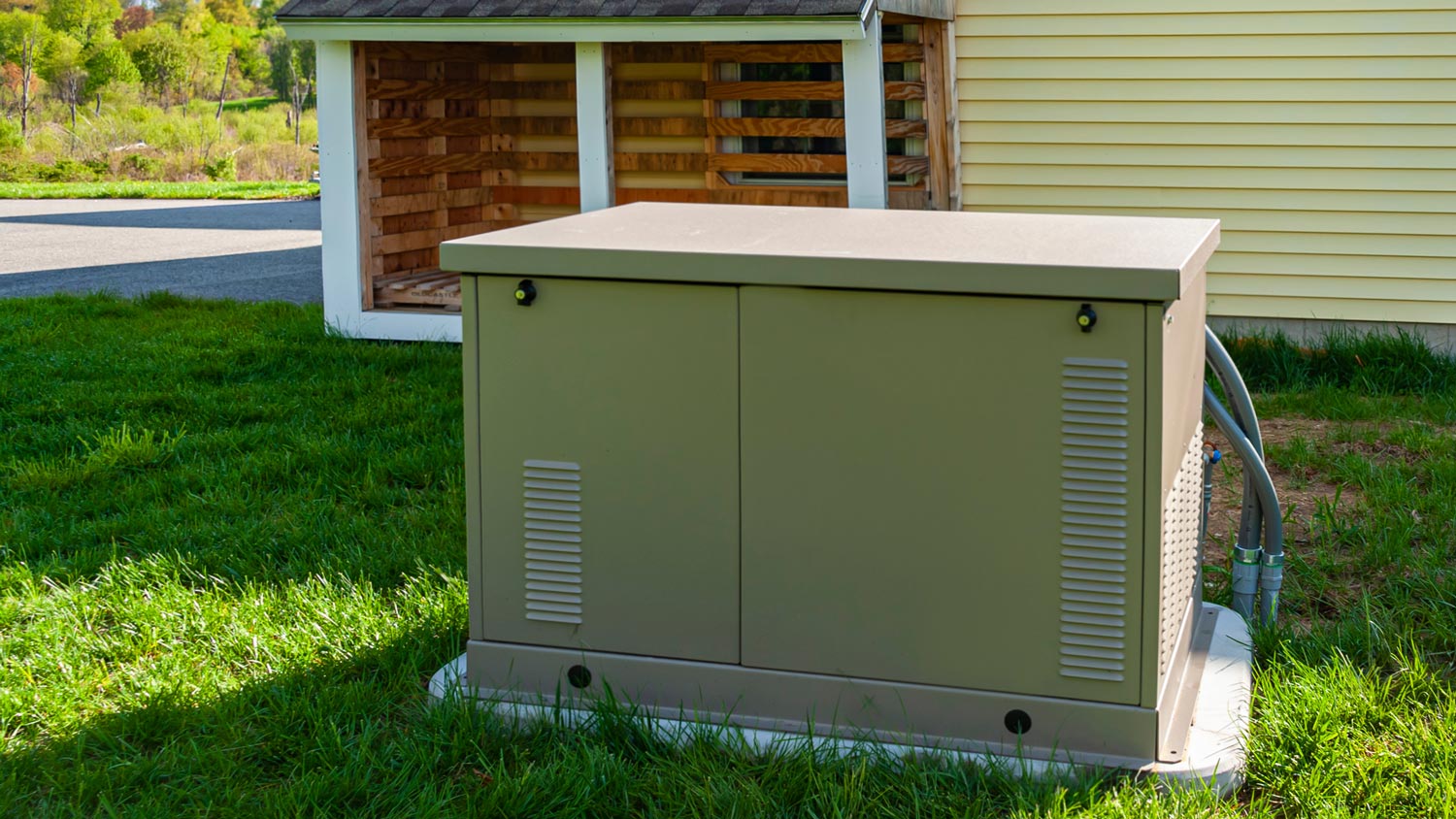
Standby generators are backup generators and all fall in the same $5,000 to $25,000 price range. Backup generators are all types of generators that produce power for your home, business, or job site. Standby, portable, and solar options are all backup generators (or backup systems in the case of solar or battery banks).
A standby generator pricing is about $17,000 installed in most homes, including an automatic transfer switch and labor. Standby generators turn on automatically and are wired directly to the home with a backup fuel supply. You'll pay as little as $3,000 for a simple critical systems generator in a smaller home or $20,000 to $45,000 for large homes needing a whole-home solution. For large luxury homes with amenities like heated pools, outdoor kitchens, and saunas, expect to pay around $50,000 or more.
Portable generators cost about $2,000 to $10,000. Although not required, a power transfer box, manual transfer switch, and cords add another $500 to $2,000. They’ll never power your entire home, but they make excellent backups for areas with little chance of blackouts or brownouts.
When shopping for a home generator, consider the power source it’ll run on. For example, if you purchase a gasoline generator, you’ll have to budget for the gas cost and storage. Other fuel types include liquid propane, diesel, and even solar.
| Fuel Type | Average Price Range |
|---|---|
| Natural gas | $2,000 – $21,000 |
| Liquid propane | $2,000 – $21,000 |
| Diesel | $3,000 – $20,000 |
| Gasoline | $500 – $3,000 |
| Solar | $2,000 – $25,000 |
| Battery backup | $10,000 – $25,000 |
Natural gas generators cost around $2,000 to $21,000 for home models. You won’t find any portable options since natural gas is piped in. They don't require fuel storage because they connect to the utility grid. They work extremely well for cold climates and can usually be converted to propane easily.
Propane generators cost about $2,000 to $21,000 for home models, while portable options run $600 to $2,600 on average. They’re a popular option for off-the-grid and rural areas or where no natural gas lines exist. Almost all natural gas models can also quickly be fit to run on propane. Liquid propane burns clean and has an indefinite shelf life when stored correctly.
Diesel generators cost around $3,000 to $20,000. These large units run more efficiently than natural gas or gasoline generators. The more power you need, the more beneficial a diesel model becomes. But, you’ll have to worry about high fuel costs, and diesel can gel in cold climates.
Gasoline generators are the most cost-effective option at approximately $500 to $3,000. Gasoline-powered generators are almost all smaller, portable options. Because gas is readily available in most regions, this is a popular choice. High gas prices, however, can make it a less economical option.
Solar generators cost around $2,000 to $25,000 for most homes. Most whole-home units cost $10,000 or more. Sustainability is a big benefit to solar backup systems. These don't require a constant fuel supply.
However, small units can’t store large amounts of energy. They also can’t produce when there’s no sun, which isn’t great for areas with higher cloud coverage. On the plus side, fuel costs nothing, and these units often pay for themselves over time if used regularly to help power the home.
A battery backup costs around $10,000 to $25,000 for whole-home units. Smaller backup batteries for critical components run as low as $2,000. Installation costs around $800 to $1,500. Fuel costs depend on whether you’re pulling from the grid or a solar array, but overall, it’s one of the most inexpensive backup options to run.
While most battery backup systems are usable with a solar panel, many don’t require solar to function. Most can attach directly to your home’s power supply and charge on the grid, storing power for emergency use. Some smaller batteries can switch on during peak hours, reducing your electricity bill.
Besides the unit itself, you’ll also pay an additional $1,500 to $5,000 on average to have it installed. This accounts for concrete installation, transfer switch purchase and installation, permits, maintenance fees, and more.
Concrete pads cost around $250 to $500 to pour for a generator. You’ll need one for a stationary standby unit.
A transfer switch transfers the incoming power from the city grid to your generator so you don’t need to plug anything directly into the generator. It can be added with manual functionality for portable units and automatic for standby units and costs around $800 to $2,000, including labor.
The cost to hire an electrician is about $200 to $600 and will take a pro three to four hours to install a transfer switch. The switch itself ranges from $300 to $1,000, not including the wiring or labor.
Permits cost around $50 to $200 each. Actual costs depend on local pricing and what you’re installing. You’ll likely need a permit for both the electrical upgrade and plumbing in a fuel tank or line.
An annual generator maintenance service costs about $80 to $300. A regular inspection before the summer and winter (the seasons where you’ll most likely lose power) will keep your generator running smoothly and help you find any issues before they worsen.
The cost to run a generator each day depends on the fuel type. On average, you’ll spend:
$90 per day for natural gas for a 21kW unit
$100 per day for gasoline for a 5kW unit
$175 per day for diesel for a 20kW unit
$220 per day for propane for a 20kW unit
As you can see above, gas-powered generators put out significantly less power than other units, primarily because they’re often used for smaller applications.
An electrical subpanel costs about $530 to $2,000, but you don’t always need to upgrade this. Adding a circuit costs $500 to $1,000 on average. If you plan to bury a line, you’ll need to dig a trench as well.
Generator enhancements can help your unit run more efficiently. Here are a few options to consider:
Wireless monitor: Costs around $200–$400 and gives access to the generator status when you’re away from home
Smart load manager: Costs around $150–$300 and creates different zones to switch the power between them
Installing a permanent home generator costs about $1,500 and $5,000 in labor and materials. Portable units are mobile, but you may still choose to install a transfer switch and power inlet box. Most pros charge on a per-project basis. However, some contractors charge according to individual factors, such as the following.
Assessing energy needs: Usually free with installation
Preparing the site and constructing the concrete pad: $50–$75 per sq. ft.
Adding a fuel tank or connecting to existing utility lines: $50–$100 per hour
Improving the electrical panel, transfer switch, and new wiring: $65–$85 per hour
Materials and equipment: $300–$2,000
Leave home generator installation to the pros. This project involves hooking up electricity to the generator and other electrical work costs. There’s also a risk of potentially damaging city lines if the electricity is fed back to the grid during a power outage. Plus, you'll need some type of fuel hookup.
Portable generators are great DIY options, but hire a local generator installer if you decide to use it with a manual transfer switch.
Do you warranty your work?
Do you offer annual maintenance plans?
How large of a unit does my home need?
How large of a unit do I need if I want to expand my electrical usage?
What type of fuel is best for my area and climate?
Perform generator maintenance at least annually. Perform these tasks on the schedule outlined in your owner's manual:
Change the oil annually.
Change the air filter every two to three years.
Change the spark plugs every two to three years.
Clean the area in and around the unit.
Test the battery annually and replace it as needed.
A generator can last up to 50 years with regular maintenance, with most standby generators lasting up to 3,000 hours total. Avoid running your unit for more than 500 continuous hours, and look for extended warranties to maximize your investment.
The size of your generator depends on the home size and its power consumption. You'll need more for a home with central AC, electric heat, and electric appliances. Most mid-size homes in the U.S. need one that produces between 22kW to 32kW of power for a whole-home backup. For critical circuits, you'll only need about half that. If you have amenities like a heated pool or sauna or live in extreme heat or cold with electric heating, you may need up to 45kW or more.
There are a few strategies for saving money on a whole-house generator, including:
Buy the generator yourself and hire separate contractors to install the concrete and electrical.
Purchase a battery backup that feeds off the grid, use it during peak times when electricity costs more, and charge it during off-peak hours.
Install solar panels to take off some of the load, then purchase a smaller unit.
Installing a generator is worth it if you work from home, have electrical medical equipment, or just want peace of mind knowing that your home can run uninterrupted during power outages and natural disasters.