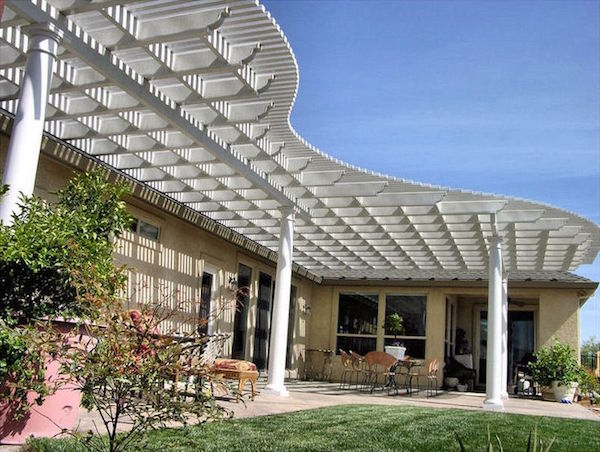
Pergolas are a great way to create a sense of wealth, luxury, and style for a reasonable price. They can provide cover for all sorts of outdoor living spaces, most commonly patios and walkways. Of course, patios and walkways come in different shapes and sizes, so you’ll probably need a pergola plan to get the most from pergola installation. Whether you want your pergola to cover your entire walkway or patio is one basic decision you’ll need to make in your pergola plan. Another great pergola idea is to install a freestanding pergola in your garden. Pergolas make for great “garden bones,” framing your garden with a permanent, decorative structure.
Pergola Plan for Patios and Walkways
Many homeowners like the idea of installing a partial pergola covering to allow some sunshine onto their patio or walkway. A smaller pergola will also be a cheaper project. Consulting with a professional builder on your pergola plan is a great way to manage a small pergola without making your patio or walkway look uneven. For long walkways, you want also want to consider installing a series of smaller pergolas. Once you know the basic design of your pergola, you’ll next need to decide what building material you’d like to use for your pergola.
Aluminum Pergola
Aluminum pergolas are cheaper than wood, easier to maintain, won’t rust, and are nearly pest-proof. Of course, they may lack the traditional feel of wood lattice work, but the facts are that a wood grain can create an amazing wood imitation and much of your pergola may be covered with vines anyway. By adding a powder coat, you can cure your paint finish onto your aluminum pergola making it all but indestructible and extending its lifetime indefinitely.
Ready to start your pergola?
Find ProsVinyl Pergola
One of the only alternatives that can go toe-to-toe with aluminum for your pergola constructions is a vinyl pergola. Vinyl pergolas are just are even more maintenance free than aluminum pergolas, if that were possible. You can probably find both aluminum and vinyl pergola companies that offer lifetime guarantees.
Vinyl is more flexible than aluminum and has a softer feel that more closely resembles wood. Unfortunately, most vinyl building companies don’t offer vinyl pergolas in nearly as many color and decorative choices as aluminum. In other words, if you’d like to imitate the look of wood lattice, go with an aluminum pergola, if you’d like to imitate the feel of wood lattice, try the vinyl.
 Understanding Deck Construction
  Cleaning Your Exteriors With a Pressure Washer
  Deck Maintenance Tips
  Should You Build a Deck or Hire a Pro?
  3 Benefits of Under-Deck Stain

Are You Familiar With This Topic? Share Your Experience.