How Much Does It Cost to Install Laminate Flooring?
Typical Range:
$1,472 - $4,630
Typical Range:
$1,472 - $4,630
Cost data is based on actual project costs as reported by 10,533 HomeAdvisor members. Embed this data
.
.
.
.
.
.
.
.
.
.
.
.
.
.
.
.
.
.
.
.
.
.
.
.
.
.
.
.
.
.
•
•
•
•
Updated May 4, 2022
Reviewed by Robert Tschudi, Expert Home Building and Remodeling Contributor.Whether you purchased a home covered in a 1965 shag carpet or want to update your mismatched floors to look the same, laminate is one of the most durable and cost-effective flooring types. Laminate floors come in many styles and finishes, and unlike their expensive counterpart—natural wood—they’re durable enough to resist scratches and dents.
The average cost to add laminate flooring to a 200-square-foot house is about $2,983, but prices can range between $1,472 and $4,630. This price difference is due to the finish, abrasion rating, and other add-ons your contractor might recommend.
Let's calculate cost data for you. Where are you located?
Where are you located?
| National Average | $2,983 |
| Typical Range | $1,472 - $4,630 |
| Low End - High End | $500 - $8,150 |
Cost data is based on actual project costs as reported by 10,533 HomeAdvisor members.
When you choose materials for this project, you’ll encounter various factors that’ll affect the total price, including:
Square footage
Wood type
Abrasion coefficient (AC) rating
Texture and finish
Thickness
Pad underlay
Flooring features
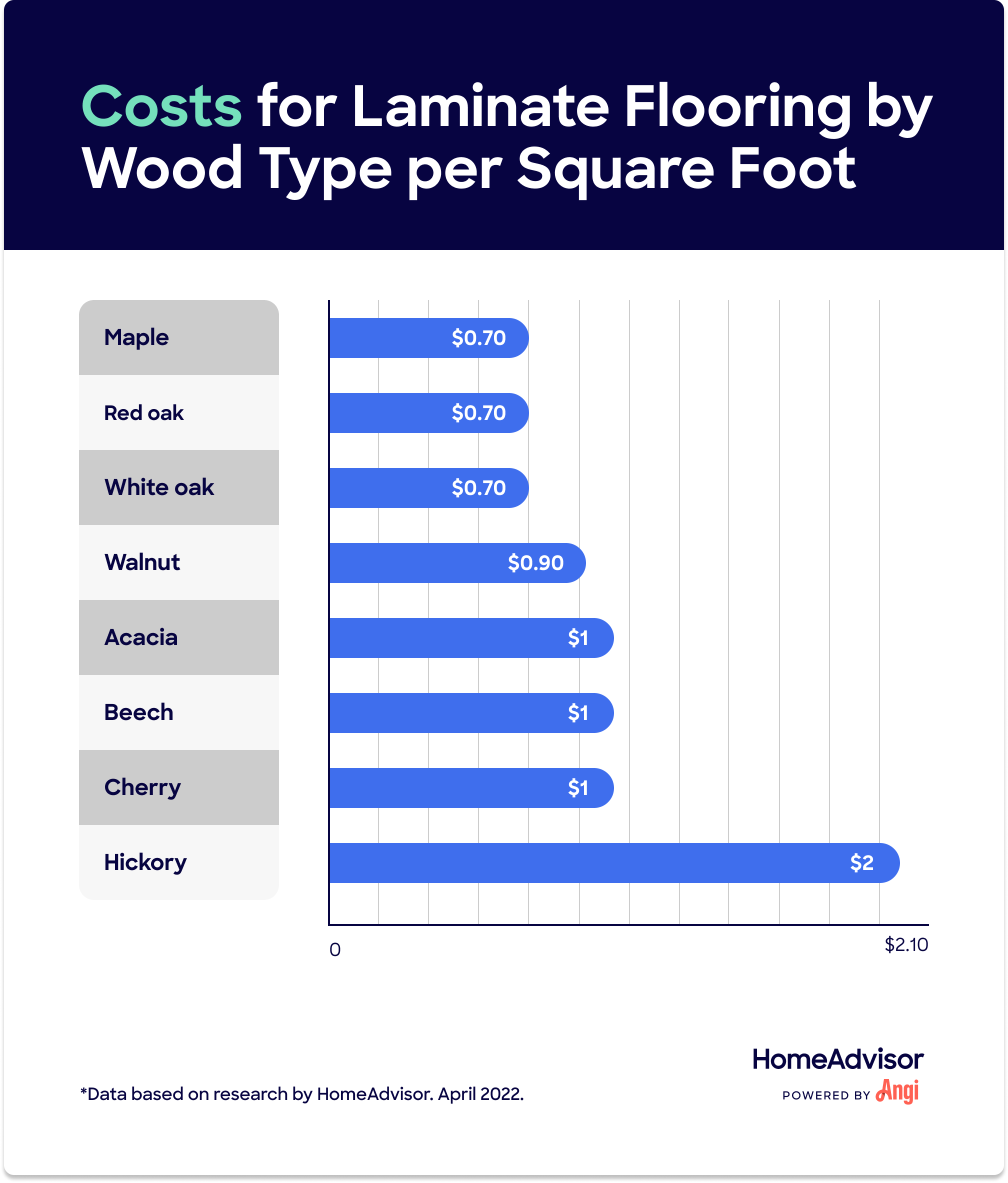
To figure out the total square footage of your room, multiply the room's length by the width. For example, if your room is 12 feet in length and 9 1/2 feet in width, your room is 114 square feet. On average, laminate flooring costs vary between $0.70 and $2 per square foot, with the average labor cost ranging between $2 and $8 per square foot.
Wood type is the first decision you’ll have to make. The most inexpensive materials are maple, red oak, and white oak. Hickory is the most expensive.
| Wood Type | Cost per Square Foot | Color and Grain |
|---|---|---|
| Maple | $0.70 | White, off-white, red-gold; swirling mixed with lighter grain |
| Red oak | $0.70 | Medium brown; heavy with slight pattern variations |
| White oak | $0.70 | Gold-brown and gray; smooth and linear grain |
| Walnut | $0.90 | White and chocolate hues; thick and heavy |
| Acacia | $1 | Light and dark brown; deep contrasting grain |
| Cherry | $1 | Dark red-brown; linear, flowing grain with small knots |
| Beech | $1 | Light tan and slightly pink; fine and placed together seamlessly |
| Hickory | $2 | Tans and red-brown; thick grain and intricate patterns |
With so many options, selecting the right color and wood type for your house might feel like a daunting task. For example, if your house has a picturesque farmhouse vibe, a contractor might suggest going with a more rugged, textured option. But if you're renovating a modern apartment, they may suggest a smooth matte look. A pro will be able to direct you toward an option that's appropriate for the home’s age, style, and color scheme.
The AC rating is just a shorthand way of ranking laminate by its durability. AC levels run from 1 through 5, with 5 being the most durable. Typically, the highest-needed rating for residential laminate is AC 4, with AC 5 generally used in industrial and commercial areas. Still, you don't have to avoid AC 1-rated laminate floors.
For areas with lower foot traffic, such as bedrooms or closets, AC 1 is a perfectly durable option. But areas with higher foot traffic, like the kitchen and entryway, need a higher durability rating. As you go up in AC ratings, the cost of your flooring will also rise. As you may have guessed, AC 1 flooring is usually the least expensive type.
You also need to think about texture and finish, another variable that'll affect the cost. For textures, you can choose between smooth and textured. Smooth laminate flooring is generally more affordable than textured laminate flooring since it's more likely to show dings and damage.
For finishes, you have three options: semi-matte, matte, and glossy. A matte finish tends to show footprints and dirt easily, costing less than a semi-matte. Both matte and semi-matte finishes are generally more affordable than laminate with a glossy finish.
Laminate flooring ranges from 6-millimeter thick to 12-millimeter thick. Thicker laminate flooring is more resistant to bending when installed over a bumpy or uneven surface and can feel sturdier as you walk and move on it. As the thickness increases, you can expect the cost to increase as well.
Underlay is a term for the padding placed below a floor. It protects against moisture, absorbs sound, and minimizes any sloping on your floors. For homeowners who don’t want any surprise expenses after buying flooring, they should find a type of laminate that comes with underlayment or padding already attached.
Underlay can also be purchased separately and typically comes in 100-square-foot rolls, at about $15 to $20 per roll. This price may increase due to the underlay quality and thickness. One large drawback is that it’ll take longer to install because the padding will have to be measured and cut separately.
Different brands offer special features that may be more or less attractive to you, depending on your lifestyle. Each additional element will add to the overall cost of your materials. Special features can include:
Water resistance
Scratch resistance
Noise resistance
Approved for use with radiant/underfloor warming
Approved for use over a cork overlay
Before you or your pro can install the laminate floor of your dreams, you’ll need to consider labor costs for your existing subfloors and laminate floors.
Anytime you replace or repair your flooring, you'll want to ensure there's no damage to your subfloor, the thick flat surface where all the other layers rest. Installing new flooring over a damaged subfloor will cost you down the line as your floors begin to sag or experience water damage. In general, the cost to replace subflooring ranges from $1.50 to $7 per square foot. The most significant cost factor comes from the wide range of labor prices depending on the region.
If the subfloor requires replacement, hiring a pro is highly recommended. The average cost for roughly a 300-square-foot room costs about $550, and expect to pay about $25 to $35 per hour in labor costs.
It costs an average of $400 for a pro to remove old laminate from a 200-square-foot area. If you want to cut down on costs, remove the existing flooring on your own before a contractor comes in to install the new one. Be careful not to damage your subfloor in the process.
As with any flooring type, some advantages and disadvantages come with choosing laminate over hardwood. Price is the biggest pro for most homebuyers. Laminate floor costs about $1 per square foot, whereas hardwood ranges from $5 to $8 per square foot. Additionally, installing a laminate floor is about $3,300, while the price to install hardwood floors is about $4,600. The benefits of installing laminate flooring over hardwood flooring include lower cost, easier maintenance, longer durability, various style options, and ease of installation.
Like many home projects, the cost to install laminate flooring fluctuates throughout the year. In most regions, prices are highest in the fall before the holidays and lowest in late winter. Some home experts recommend getting a quote in the off-season, even if you need to delay the work a little.
“We always buy about 20% extra and put it in the attic or other storage area,” says Bob Tschudi, Angi Expert Review Board member and Raleigh, NC-based general contractor. “That way, when there’s a problem such as a gouge or other damage, it’s a matter of popping out the bad board and installing a brand-new board from the same manufacturing batch.”
Or better yet, save money by handling the installation process yourself, particularly if you’re installing snap-together laminate panels for a small room like a hallway or bedroom. For more complicated spaces, like rooms with complex angles or busy areas, hire a laminate flooring pro near you to ensure the job gets done correctly and safely.
Laminate flooring is made of multiple layers of synthetic material bonded together. This often includes layers of natural wood and particle boards. Usually, the top layer is a thin piece of natural hardwood, meaning you can feel and see the actual texture of natural wood.
The cost to install laminate flooring for a 12-by-12-foot room ranges from about $390 to $1,400. Prices will vary depending on the materials you select and the labor cost in your area. For example, hardier woods like hickory may cost around $290 just for the materials, while affordable maple can cost around $100.
In many cases, installing carpet may be more expensive than laminate flooring. The average cost to install carpet in a 330-square-foot room is $1,800, while installing laminate flooring in the same area ranges from $890 to $3,300. Both laminate flooring and carpet can vary widely in quality and price, with some carpets costing much more than laminate.
“We like to use laminate flooring when we’re replacing carpet in flip-house situations. The material is inexpensive, the installation is easy and inexpensive, and it really looks good,” says Tschudi.
Laminate flooring comes in a variety of colors, finishes, and textures. The color and look of laminate flooring include:
Cherry
Oak
Maple
Acacia
Beech
Walnut
Hickory
Laminate flooring finish options include:
Matte
Semi-matte
Glossy
Laminate flooring texture options include:
Smooth
Textured
Most laminate manufacturers include a 10-year warranty with their products and usually cover factory defects, stains, and fading from the sun. To prevent voiding your warranty, don’t use abrasive cleaners like bleach or steel wool when cleaning your laminate floors, and ensure you protect them from water damage or pet urine. Take the time to read the terms and know what's covered to save yourself stress and hassle down the road.