How Much Does It Cost to Frame a House in 2023?
Typical Range:
$1,408 - $7,515
Typical Range:
$1,408 - $7,515
Cost data is based on actual project costs as reported by 2,354 HomeAdvisor members. Embed this data
.
.
.
.
.
.
.
.
.
.
.
.
.
.
.
.
.
.
.
.
.
.
.
.
.
.
.
.
.
.
•
•
•
•
Updated August 9, 2022
Reviewed by Cati O'Keefe, Expert Home Building & Sustainability Contributor.It costs an average of $4,425 to frame a house, including labor and materials. House framing projects tend to cost between $1,408 and $7,515, with prices varying by the type and size of the project. Small, simple framing projects like a garage addition may cost as little as $300, while large projects like whole-house framing for custom builds can cost $32,000 or more.
2022 Notice: Material Prices Are Surging
Demand for lumber and steel has grown over the past year. And, as a result, manufacturers are increasing materials prices. Prices have gone up 5% to 10% this year, and many parts of the country are experiencing long delivery times. If you're planning a project, we recommend starting as early as possible in the season, preparing for potential price fluctuations, and allowing extra time to order materials.
Let's calculate cost data for you. Where are you located?
Where are you located?
| National Average | $4,425 |
| Typical Range | $1,408 - $7,515 |
| Low End - High End | $300 - $20,000 |
Cost data is based on actual project costs as reported by 2,354 HomeAdvisor members.
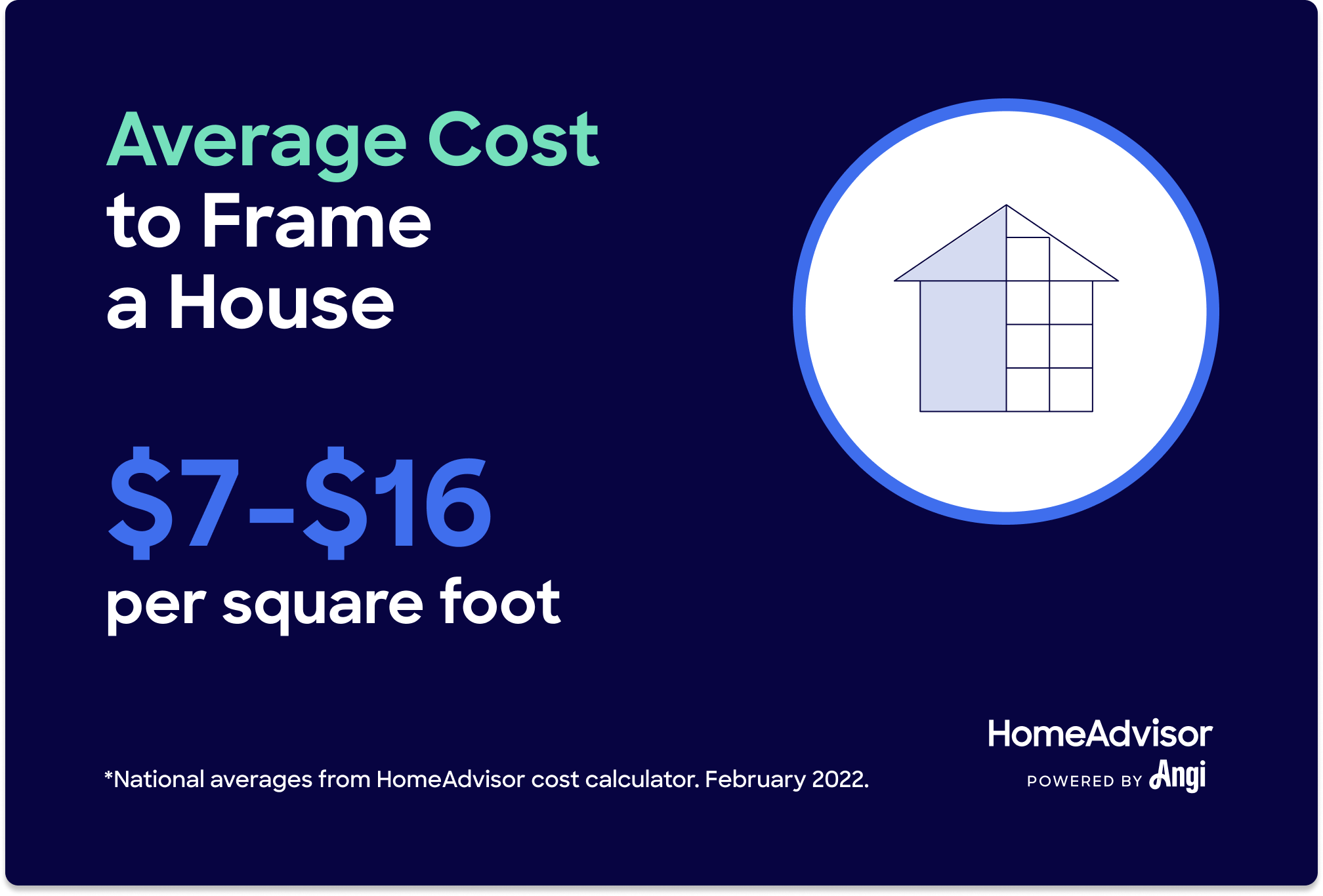
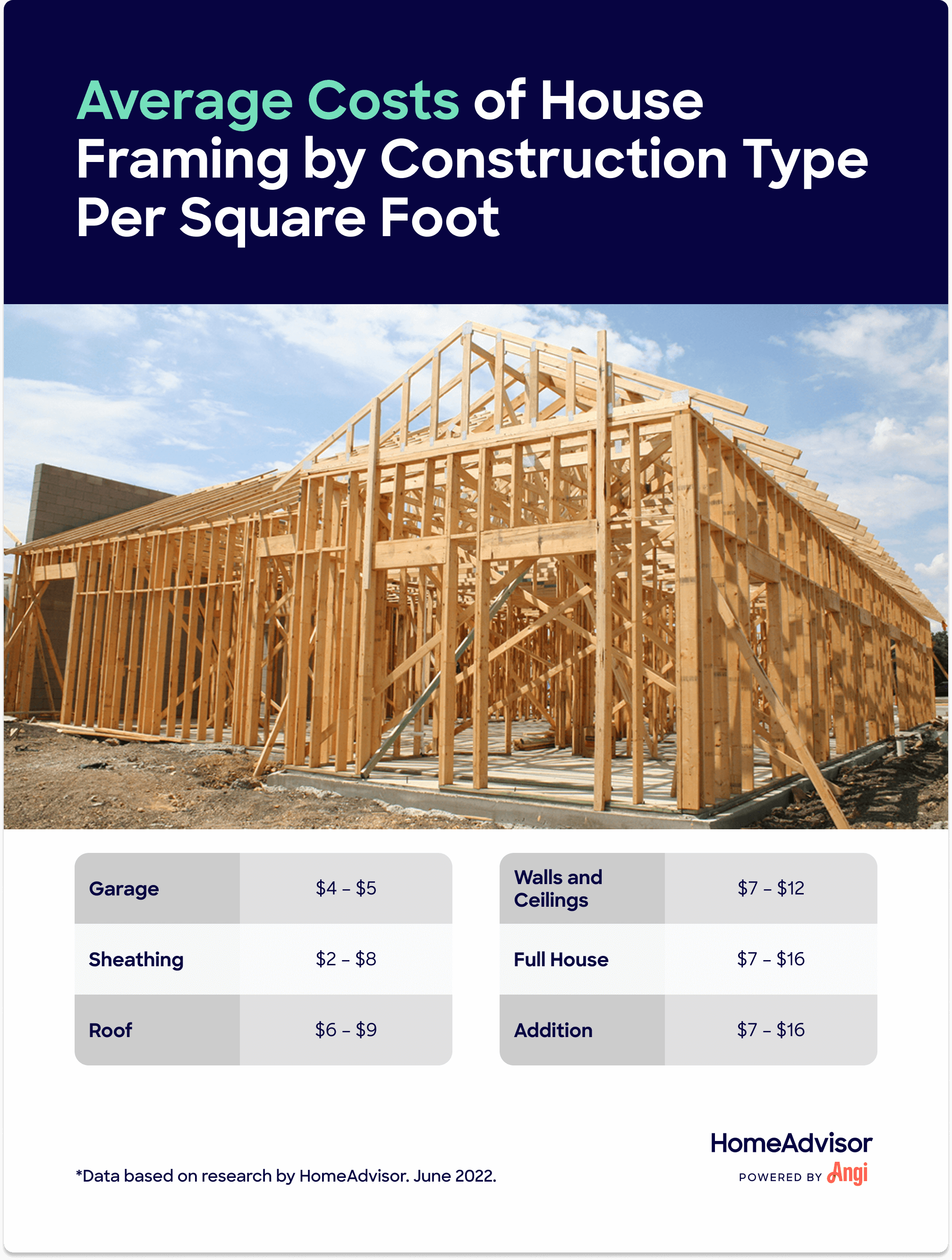
On average, the house framing cost per square foot is $7 to $16 per square foot. That includes $4 to $10 per square foot for labor plus $3 to $6 per square foot for materials. You may pay less for simpler structures like garages, which tend to cost only $4 to $5 per square foot total. If framing a two-story home, the second story may cost an additional $3 per square foot.
There is more than one kind of home construction, and specific jobs have their own considerations when it comes to the cost of framing.
Framing costs for the average, 2,000-square-foot single-story home run $14,000 to $32,000 plus an additional $4,000 to $16,000 for sheathing and wrap. At most, this is just under one-fifth of the total average home building cost of $290,000. The cost to frame the second story of a two-story home generally runs about $3 per square foot more than framing for the first floor.
Framing makes up 8% to 12% of the cost of a home addition. For example, framing for a 500-square-foot addition costs $3,500 to $8,000, with a total project cost of $30,000 to $100,000.
Final home addition costs depend on the type of addition, the grade of materials used, and the design details. A simple box frame with no bump-outs or insets is far less expensive than one with complicated angles that require special framing. You may also need to factor in the cost to hire a local architect or structural engineer near you to determine the best placement for an addition before framing.
Framing for basement walls in established homes runs on the lower end of the cost spectrum at about $5 per square foot. These walls aren't load-bearing or complex and don't usually require extensive planning.
Garages are usually the simplest structure to build onto a home, falling on the lowest end of the range of costs for house framing at $4 to $5 per square foot. However, the type of garage you choose to build may increase costs. For example, adding an attached garage tends to be less expensive than building a detached garage. Larger garages will also drive up framing costs.
Interior walls and ceilings are usually $7 to $12 per square foot. On average, interior wall projects cost $1,900. Expect additional costs when adding interior walls to an already established home due to the challenges that arise. These include less room to work, and extra care needed to avoid dust and debris since the homeowner is often living in the residence during construction.
Roof framing costs $6 to $9 per square foot. Simple designs without dormers and few valleys or hips—the place where two slopes join—will fall on the low end. Complex designs with numerous angle changes and dormers will end up on the higher end of the spectrum. To lower overall project costs, consider using premade roof trusses.
Roof trusses cost between $35 to $150 per truss depending on the length. Trusses for a standard 2,000-square-foot home run between $7,200 to $12,000, including labor and equipment.
Roof trusses are premade roof framing members 10 to 36 feet in length. Though they cost more per piece than wood rafters for a stick frame roof, they require less material and are easier to install, reducing labor costs.
Sheathing, which serves as a surface to add other structural elements to the home, will cost an additional $2 to $8 per square foot. Often, contractors will also install house wrap such as Typar or Tyvek to serve as a weather-resistant barrier for an additional $0.50 to $1 per square foot.
The frame is the single most expensive part of a new home, and framing costs aren’t based on square footage alone. The total cost to frame a house will vary depending on a variety of contributing factors.
Size matters because contractors estimate per square foot. However, it matters far less than complexity. The more complex your building plans, the more you can expect to pay for house framing. Every intersecting wall requires more studs, increasing your material costs. Extra slopes and valleys add even more time and materials.
For example, framing a simple, 3,000-square-foot home estimated at $4 per square foot only costs $12,000, while framing for a complex, 2,000-square-foot, two-story home estimated at $9 per square foot has a higher total price of $18,000.
The cost to frame commercial properties is higher than for residential homes at a range $12 to $40 per square foot including labor, installation, and insulation. This is, in part, because most commercial buildings use steel construction rather than wood.
If you decide to make any changes after framing has begun, it will increase the price. Increases depend on many variables specific to each project—making a general estimate for this guide impossible. Simple changes like adding a door, moving the location of a window, or adding loads to a second floor all affect the final bill. Try to keep these changes to a minimum.
Labor for house framing costs $4 to $10 per square foot. In urban areas, expect to pay on the higher end of this range. In areas with high demand, you may even pay a little more. The size of the project significantly impacts the cost of installation. Some professionals charge per square foot rather than the amount of time a project takes. Regardless, bigger homes take longer and require more materials.
When framing a house, windows are considered obstructions with special framing requirements that can increase costs. For example, there needs to be header material installed over all windows in a wall.
Replacing all or part of older framing on an existing home comes with additional costs. On top of the materials and installation required for new structures, replacement also requires the cost of home demolition.
For example, new roof construction often costs less than replacing a roof at an average of $20 per hour for labor plus $3 to $6 per square foot in materials. Replacing an old roof frame requires an additional $4 to $15 per square foot on top of those costs.
Framing materials run from $3 to $6 per square foot. Since lumber pricing fluctuates, it can be tough to predict costs in advance. You'll pay $350 to $500 for 1,000 board feet of lumber. Metal framing costs historically tend to run a bit higher than wood by about 10%. Check with your local lumber yard or general contractor for local pricing.
Lumber costs $1 to $5 per square foot with overages for waste ranging from 15% to 20%. A 2,000-square-foot home comes in at $2,000 to $10,000 in materials. For sheathing, add an additional 15% to 22%. Lumber is easy to work with, quick to install, and lasts the life of the home.
Steel framing costs $2 to $4 per square foot or about $4,000 to $8,000 for a 2,000-square-foot home. Some homes use steel, but it's most common in commercial construction. Steel installation labor is also slightly more expensive at $1.50 more per square foot. Steel is extremely durable, has a lower environmental impact, and holds up better against termites.
To come up with a rough estimate for framing costs, a contractor will commonly look at a building plan to determine the complexity of the job. This may be based on details like specific angles, windows, or roofing elements that deviate from a standard box frame or A-frame. Based on this assessment, they will apply a price per square foot.
When receiving detailed bids, ask contractors to break out costs as line items. They should include insurance, travel expenses, waste, materials, labor, tools, equipment, and administrative expenses such as legal and accounting fees.
House framers tend to make between $12 to $30 per hour with an average hourly rate of $20. They usually receive additional benefits like health insurance and retirement contributions for another 30% of their salary. Framer salaries are just one small part of overall construction costs, which include overhead, marketing, insurance, travel, and tools and supplies.
Here are some tips to follow when hiring a framer or contractor:
Get at least three bids.
Ask to see samples of previous work or talk to previous clients.
Use a general contractor to find framing contractors. Framing contractors tend to have loyalty to general contractors who provide them ongoing work versus a homeowner with a one-off project. This translates into better rates and better work.
Interview all contractors and trust your instincts. Go with the professional you feel is right for the job.
Get a clear and detailed contract.
Submit all changes and requests to your contractor in writing.
It usually takes between five and eight weeks to frame a home. This timeframe can vary depending on the size and complexity of the home you’re building, as well as unforeseen factors such as the weather.