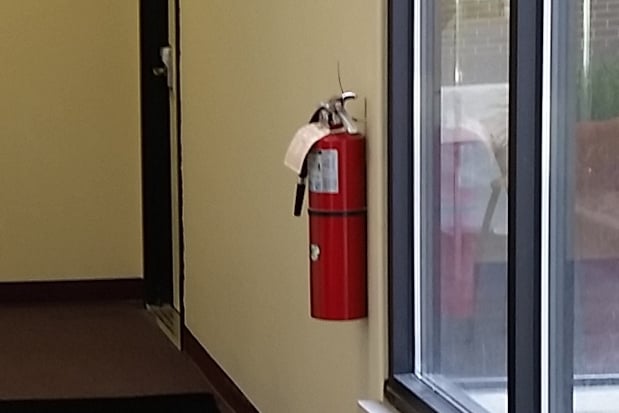
Fire extinguishers have a role for only a brief moment at the beginning of a fire. Though it would be better to never have to use them at all, one aspect of fire safety is to place extinguishers throughout the house so that no matter where the fire starts, a way to put it out will be near. There should be one in the kitchen, garage, workshop, basement, and near any sleeping areas. Additionally, there should be at least one on each floor.
Types of Fires and Fire Extinguishers
There are several different kinds of fires. Since the nature of each kind of fire is different, the fire extinguisher used on each kind of fire must be appropriate. Type A fires refer to fires caused by paper, wood, fabric, and other easily ignited household materials. Type B fires involve gases and liquids such as gasoline, solvents, and grease. C-type fires are commonly referred to as electrical fires. D-type fires are generally only a concern in industrial settings and involve fires caused by burning metals such as magnesium and sodium.
Many fire extinguishers are designed for use against more than one type of fire. All extinguishers carry a label that states which fire types they are effective against and also numbers that indicate how big a fire they can take on. Thus, an extinguisher marked 5-B, C would be designed to put out a five square foot grease fire as well as an electrical fire, but not a paper fire. On the other hand, one rated 3-A, 10-B, C would be effective against a small paper fire, a larger chemical fire as well as an electrical fire. There is never a numeric rating for the Type C fires, because as soon as you cut power to an electric fire by shutting down a circuit breaker, removing a fuse, or unplugging the device, the fire ceases to be a Type C fire and reverts to either a Type A or a Type B.
Ready to start your Fire Safety Project?
Find ProsFire Safety: What Fire Extinguisher Is Right For You?
You might be tempted to go out and buy large extinguishers rated for all three fire-types of residential fires, but in most cases, that is not your best option. First, large extinguishers can be hard to handle, especially by younger children and the elderly. Second, many fire extinguishers, especially ones rated for Types A, B and C, contain highly corrosive chemicals. While it’s nice to be able to put out a small fire in your home office, you might be less thrilled when you discover that the chemicals in the extinguisher destroyed the very electronic equipment you were seeking to protect. Most home-use extinguishers contain either halon or various dry chemicals. Halon, a very effective Type B, C extinguisher, is being phased out because of concerns about its effect on the ozone layer.
For most, a Type B, C extinguisher with non-corrosive chemicals is your best bet. After all, there is nearly always a nearby source of water, which is a very effective Type A extinguisher. However, even with non-corrosive extinguisher chemicals, it is important to clean up all the powder after a discharge because the powder can cause short circuits in electronic equipment.
Fire Safety: Proper Extinguisher Placement
Fire extinguishers should be mounted or placed in a highly visible location 3.5 to 5 feet above the floor, out of the reach of small children. They should not be too close to potential fire locations such as stoves or trashcans or a fire may prevent you from getting to the extinguisher. In addition, extinguishers are under pressure and should not be located near any heat sources such as radiators or vents. In case of fire, you do not want to move away from avenues of escape in order to reach the extinguisher, so place it near or en route to an exit.
The Most Important Aspect of Fire Safety Is Being Prepared
Fire extinguishers are only effective at the birth of a fire. Within seconds, or at most, minutes, most fires will outstrip even a large fire extinguisher’s dousing capacity. There is no time to read long and often convoluted instructions. In addition, most extinguishers discharge for only 8 to 12 seconds. That is not much time if you are confused about how to hold it and where to spray. For this reason, it is important that you conduct drills that give older children and every adult an opportunity to become familiar with extinguishers and their use.
Often the best way to accomplish this is to incorporate the drill into an annual tradition such as Fourth of July, Halloween, or Thanksgiving. After reviewing the instructions, start a small fire in a barbecue, fire pit, or metal trash can and use an extinguisher to douse it. It can be an exciting and life saving addition to your tradition.
Use the same occasion to make sure that all your extinguishers are visible, clean, and fully charged. Most have a small gauge or a pressure-test pin. Larger units can be recharged by professional companies found in the yellow pages. Smaller ones often aren’t rechargeable and should be discarded and replaced.
It may be beneficial for you to have a fire safety inspection done by a professional in your area. He or she may be able to give you some additional tips on fire safety, and should be able to identify potential problem areas that might become an issue during an emergency.
Using a Fire Extinguisher
Always follow the specific instructions on the label of your fire extinguisher. In most instances these instructions will include some variation of P.A.S.S.:
Pull the pin.
Aim at the base of the fire.
Squeeze the trigger.
Sweep the spray back and forth, as you approach the shrinking fire.
 11 Home Security and Safety Tips
  Staying Safe During a Home Power Outage
  Home Improvements to Prevent Kitchen Fires
  Best Cities for Sidewalks and Winter Safety
  Surveillance Equipment

I really like that you talked about using a fire extinguisher. I think that a lot of people don’t understand the importance of knowing how to do that. However, it takes practice and a knowledge of how to use a fire extinguisher. Do you have any other tips about finding the right fire extinguisher and then maintaining it?